
Plant Safety

Modern machinery and industrial plants are becoming increasingly complex. They are characterized by innovative designs, new materials and efficient operating materials. The associated risks and hazards throughout the product life cycle are diverse and complex. At the same time, safety requirements are increasing at both national and international level. Our consulting and engineering services enable our customers to properly assess risks and hazards and to comply with statutory requirements. Particular consideration is given to the cost-benefit ratio. Our services include:
Risk Assessment

The requirements for plant safety applicable to operators are primarily determined by statutory provisions under the German Ordinance on Industrial Safety and Health (BetrSichV) and the German Product Safety Act (ProdSG). The legal framework of the Product Safety Act is based on Regulation (EC) No 765/2008 and Decision No 768/2008/EC of the European Parliament and of the Council, as well as other European Community directives. In connection with the Product Safety Act, the relevant EU directives must be taken into account depending on the technical design of the plant (Pressure Equipment Directive, Machinery Directive, etc.). The Ordinance on Industrial Safety and Health is further specified by the Technical Rules for Industrial Safety (TRBS).

Placing on the Market, Commissioning

Product Safety Act

The following must be taken into account in the technical design of the plants:

  • Pressure Equipment Directive
  • Machinery Directive
  • ...

Operation

Ordinance on Industrial Safety and Health (BetrSichV)

The Technical Rules for Industrial Safety (TRBS) provide further detail on the requirements of the BetrSichV:

  • TRBS 2101

    (Dampf/Druck)

  • TRBS 2111

    (mechanische Gefährdung)

  • ...

The current regulatory framework defines a wide range of requirements. At the same time, manufacturers and operators have a certain degree of flexibility in how these requirements are designed and implemented. In many cases, no specific requirements are provided, for example with regard to limit values or inspection intervals. Depending on the specifications of the plant, these must be determined by the manufacturer or operator under their own responsibility, taking the associated risks into account. In the case of plant modifications or extensions, the operator may additionally assume the responsibilities of a manufacturer. The expenditure required to comply with statutory requirements contributes only indirectly to value creation.

  • Product Safety of Pressure Vessels
  • Safe design and manufacturing:
    wall thickness
    welds
    materials
    …
  • Design / Service Life
    Risk Assessment
  • Operational Safety
    of Pressure Vessels
  • Safe operation and maintenance:
    risk of explosion
    burns from contact
    depressurized maintenance
    …
  • Inspection with regard to service
    life consumption, inspection intervals and scope

Implementation in compliance with the applicable requirements while maintaining predictable costs is essential. The safe use of work equipment – and therefore the safe operation of plants – is the responsibility of the operator and is regulated by the German Ordinance on Industrial Safety and Health (BetrSichV). Compliance of the work equipment with the applicable requirements is an essential prerequisite for safe operation.

Furthermore, the operator must assess existing hazards and determine appropriate protective measures. Hazards and protective measures are documented in hazard assessments. The assessment of hazards should be based on the risk assessment required under the applicable conformity directives.

Work equipment exposed to potentially damaging influences that may give rise to hazards must be inspected at regular intervals by a competent person appointed to perform such inspections. Installations subject to mandatory inspection must be inspected prior to initial commissioning and at regular intervals thereafter.

Conformity Assessment

STURM AI supports you throughout all stages of the conformity assessment procedure:

  • Identification of the Applicable Directives
  • Preparation of the Required Risk Assessment
  • Preparation of the Required Documentation

The following procedure provides an example of the declaration of conformity for a complete energy system.

  • Creation of a Component Structure Relevant to Conformity Assessment
  • Identification of the EC Directives Applicable to the Individual Components and the Entire Plant
  • Verification of Documentation Completeness by On-Site Inspection
  • Review of the Documentation for Conformity-Relevant Documents

    (Konformitätserklärungen, Zertifikate, Prüfzeugnisse)

  • Verification of Documentation Completeness by On-Site Inspection
  • Request for Missing Documentation and Conformity-Relevant Documents

    (Konformitätserklärungen, Zertifikate, Prüfzeugnisse)

  • Preparation of the Risk Assessment for the Entire Plant
  • Preparation of the Operating Instructions for the Entire Plant
  • Compilation of the Technical Documentation in Accordance with the Pressure Equipment and Machinery Directives
  • Preparation of the Declaration of Conformity

Hazard Assessment

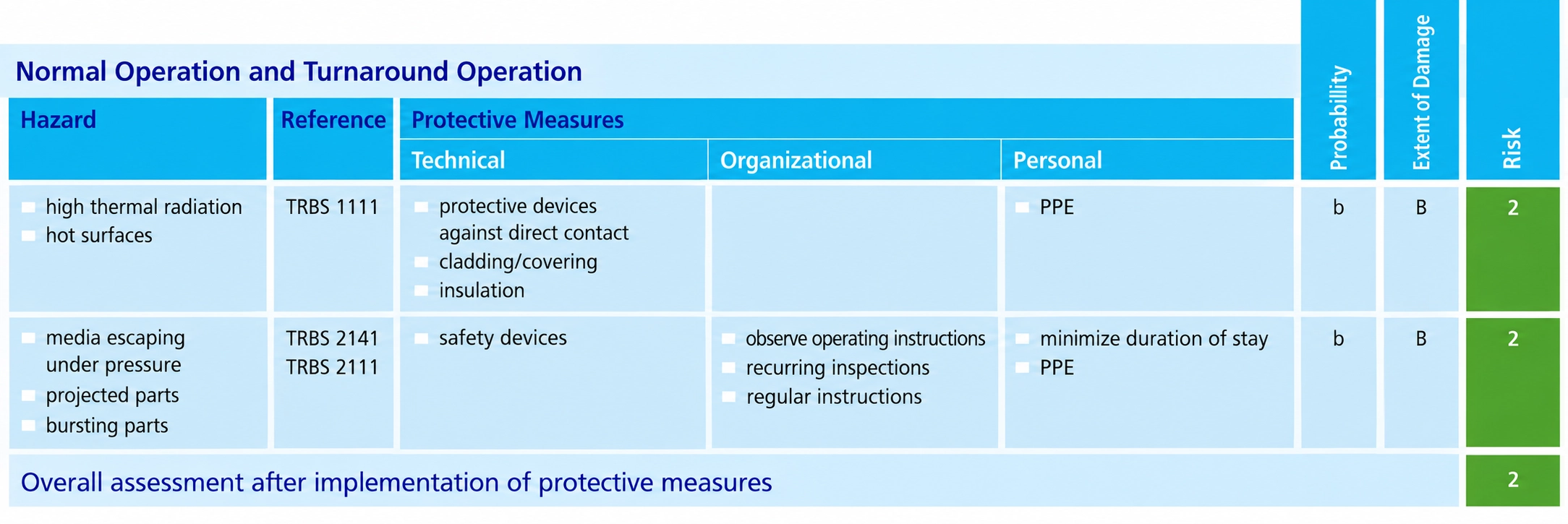
Plant operators are required under the German Ordinance on Industrial Safety and Health (BetrSichV) to prepare hazard assessments. STURM AI prepares these assessments on the basis of the declarations of conformity as well as an assessment of the plant and the activities performed. Risk assessment plays a key role within the conformity assessment process.

A suitable method for evaluating risks is the Nohl Risk Matrix.

The assessment must take into account all hazards arising from the use of work equipment, including those arising from:

  • the work equipment itself,
  • the working environment, and
  • the objects on which activities are carried out using work equipment.

The following aspects must be given particular consideration in the hazard assessment:

  • the suitability of work equipment for its intended use, including ergonomic design and design appropriate to the age and ageing of employees,
  • safety-related factors, including ergonomic aspects, concerning the interaction between the workplace, work equipment, working methods, work organization, workflow, working time and work tasks,
  • the physical and mental stresses on employees arising from the use of work equipment,
  • foreseeable operational malfunctions and the hazards associated with measures taken to eliminate them.

STURM AI prepares hazard assessments in the following work steps:

  • STURM AI prepares hazard assessments in the following work steps:
  • Identification of applicable inspection requirements, inspection intervals and the resulting measures
  • Identification of potential hazards and the applicable regulations
  • On-site inspection of the plant
  • Definition of technical, organizational and personal protective measures
  • Assessment of the residual risk after implementation of the protective measures, based on probability and severity of harm (Nohl Risk Matrix)
  • 1. Preparation, review and approval of the hazard assessment